And now that there is only a few hours left of 2010 here's the year list coming up to a total of 157, with 10 lifers (blue)and 3 Malta ticks (yellow).
1. Common Quail
2. Common Shelduck
3. Eurasian Wigeon
4. Gadwall
5. Eurasian Teal
6. Mallard
7. Pintail
8. Garganey
9. Shoveler
10. Ferruginous Duck
11. Cory's Shearwater
12. Yelkouan Shearwater
13. Little Grebe
14. Great Crested Grebe
15. Black-necked Grebe
16. Greater Flamingo
17. Black Stork
18. White Stork
19. Glossy Ibis
20. Eurasian Spoonbill
21. Little Bittern
22. Night Heron
23. Squacco Heron
24. Little Egret
25. Great White Egret
26. Grey Heron
27. Purple Heron
28. Northern Gannet
29. Great Cormorant
30. Lesser Kestrel
31. Common Kestrel
32. Red-footed Falcon
33. Merlin
34. Hobby
35. Eleonora's Falcon
36. Peregrine Falcon
37. Honey-buzzard
38. Black Kite
39. Marsh Harrier
40. Pallid Harrier
41. Montagu's Harrier
42. Eurasian Sparrowhawk
43. Osprey
44. Water Rail
45. Little Crake
46. Moorhen
47. Common Coot
48. Purple Swamphen
49. Common Crane
50. Chukar
51. Pheasant
52. Black-winged Stilt
53. Avocet
54. Little Ringed Plover
55. Ringed Plover
56. Dotterel
57. European Golden Plover
58. Northern Lapwing
59. Little Stint
60. Temminck's Stint
61. Curlew Sandpiper
62. Dunlin
63. Ruff
64. Common Snipe
65. Bar-tailed Godwit
66. Spotted Redshank
67. Common Redshank
68. Greenshank
69. Green Sandpiper
70. Wood Sandpiper
71. Common Sandpiper
72. Mediterranean Gull
73. Black-headed Gull
74. Slender-billed Gull
75. Audouin's Gull
76. Lesser Black-backed Gull
77. Yellow-legged Gull
78. Caspian Tern
79. Sandwich Tern
80. Pomarine Skua
81. Collared Dove
82. Turtle Dove
83. Common Cuckoo
84. Short-eared Owl
85. European Nightjar
86. Alpine Swift
87. Common Swift
88. Pallid Swift
89. Common Kingfisher
90. European Bee-eater
91. Hoopoe
92. Wryneck
93. Woodchat Shrike
94. Golden Oriole
95. Sand Martin
96. Barn Swallow
97. House Martin
98. Red-rumped Swallow
99. Bar-tailed Desert Lark
100. Short-toed Lark
101. Sky Lark
102. Zitting Cisticola
103. Cetti's Warbler
104. Savi's Warbler
105. Moustached Warbler
106. Sedge Warbler
107. Reed Warbler
108. Great Reed Warbler
109. Icterine Warbler
110. Blackcap
111. Garden Warbler
112. Common Whitethroat
113. Spectacled Warbler
114. Subalpine Warbler
115. Sardinian Warbler
116. Eastern Bonelli's Warbler
117. Wood Warbler
118. Common Chiffchaff
119. Willow Warbler
120. Goldcrest
121. Firecrest
122. Common Starling
123. Blackbird
124. Song Thrush
125. Robin
126. Common Nightingale
127. Bluethroat
128. Black Redstart
129. Common Redstart
130. Moussier’s Redstart
131. Whinchat
132. Common Stonechat
133. Northern Wheatear
134. Black-eared Wheatear
135. Blue Rock Thrush
136. Spotted Flycatcher
137. Semi-collared Flycatcher
138. Collared Flycatcher
139. Pied Flycatcher
140. Spanish Sparrow
141. Tree Sparrow
142. Dunnock
143. Tawny Pipit
144. Tree Pipit
145. Meadow Pipit
146. Red-throated Pipit
147. Water Pipit
148. Yellow Wagtail
149. Grey Wagtail
150. White Wagtail
151. Common Chaffinch
152. European Serin
153. Greenfinch
154. Linnet
155. Common Crossbill
156. Reed Bunting
157. Corn Bunting
A year that will be remebered for the great days on Comino on the 7th and of April and 2nd May, mega Bar-tailed lark, first record Purple Swamphen, finding birds like Snow bunting, Great snipe and Long-tailed duck in Norway, biggest number of birds of prey I have seen on 21st September as well as a flock of 21 Spoonbills, seeing the biggest flock of 28 White and a Black Stork recorded from Malta, and several other birding adventures.
Friday, December 31, 2010

The last days of 2010

The Common Crane flushed from Cuminija area behind Ghadira, taken by Nick Galea
 One of the Snipes at Simar feeding below the hide
 Scenery at Ta' Zuta close to Buskett
Christmas holidays at last and more time for birding! The 23rd of December started off at Gahdira nature reserve. Two female Teals feeding on one of the islands, eleven Black-necked and three Little grebes, the highest number of grebes I can remeber here, six coots, a Dunlin and two Common sandpipers were to be seen. A flock of 9 Shelduck were spotted flying over the bay and great to see. We went to check if they had settled on the water but all we saw were two Cormorants flying above us.
We continued to the garigue area behind the reserve. A few stonechats, black redstarts, meadow pipits, blue-rock thrushes as well as a Linnet and two Skylarks. It got more exciting when a sharp call alerted us to two Lapwings flying along the small valley. Even better and quite a surprise was a Common Crane that alighted on the opposite side of the valley 200 meters away. Circled around for a while before continuing down the coast it gave good views. Unfortunalty it was apparent that it had missing primaries altough it was flying well.
Christmas eve was windy and a walk through a valley dominated by farmland and a watercourse with abundant reeds and fresh water, was t say the least unproductive. At least I got my only Firecrest of the year in a public garden close to home.
The next two days seemed perfect for Cranes with low cloud cover and westerly winds but watching from Qawra and Dwejra was futile and indeed from anywhere on the island at that.
Monday we were off to Gozo, concentrating on Ta' Cenc, sea cliffs and one of the richest garigue areas of the island. Black redstarts were dominant. A few Spectacled warblers which are restricted to such areas. Two Linnets were good as were three hunting Common Kestrels. The definite highlight was a Golden Plover flushed from an unsurfaced road full of water puddles. I had missed a major passage two weeks earlier so at least cought up with this species this year too.
A penduline tit had been seen at Simar on Boxing day but weren't lucky with visiting the reserve on Tuesday. Little Grebes are in full breeding plumage and becoming territorial...soon chicks will be emerging from the reeds :). Other birds were three Water rail, two Common Snipe, a female teal, loads of Chiffchaffs and two Reed Buntings.
Next was an early morning at Buskett. As usual Robins were calling from everywhere as well as as less numbers of Blackcaps, Dunnocks and Chaffinches. Two Wrynecks heard but not seen as too often. A male Blackbird was flushed from a nearly dried up resevoir. Other birds inlcuded 12 Song Thrush making the best of ripening ivy berries and two Greenfinches a yearer for me and a Malta tick for my sister.
Walking to Laferla cross afterwards apart from the beautiful countryside gave nothing much but a flock of four Linnets were good though. Two large thrushes flying over gave too short views and from the back to confirm as Fieldfares rahter than the less likely Mistle thrush.
Twitched a Moussier's Redstart, female and 11th record for Malta in the evening. Altough less impressive as a male spending the winter of 2008 -2009 at Xaghra il-Hamra it was still nice to see this vagrant again on the island. Record shot by Ray Galea can be seen at http://www.surfbirds.com/cgi-bin/gallery/display.cgi?gallery=gallery11
Last two days of the year spent inside unfortunatly trying to recover from a cold so no more last minute yearers. Still many great birding experiences this year and hopefully 2011 will be even better.
Happy New Year everyone!
Wednesday, December 8, 2010
A couple of hours at Simar NR
 One of five Snipes at Simar
 Mist hanging over the Pwales valley behind Simar
 Yesterday browsing through the sightings of the day, thinking about were to go today it being public holiday in Malta, the desicion was made easy for me, 1 Penduline tit male ringed at Simar NR. The last sightings of these great birds were from 2007/2008 when a few birds wintered at the reserve. It wasn't only me that was hoping for this one to stay too and me and my sister met up with a small group early this morning at Simar.
Simar early in the morning is beautiful, dew dripping from the trees, birds breaking mirror still water with ripples, the chilly air inside the hide and the general feeling that time has no effect on the place...
Looking out over the small wetland expactantly we saw the usual Coots, Moorhens, some 4 Little Grebes and a female Teal. A total of 5 Common Snipes were feeding elussively on the banks while there was larger number of Chiffchaffs flitting about. A Wryneck called from somewhere, but straining ears couldn't pick up any penduline tit calls which I remeber to give them away first two years ago. A small bird flew down on the opposite bank, but my brain told me to late that it was probably a Bluethroat as it disspaeared behind a tamarisk...frustrating! Two, three have been present the last month or so but eluded me so far. Something flew into a tre closer to the hide however turning out to be a male Bluethroat! A much brighter coloured male turned up feeding on close to the water's edge on the other side giving great views when it flew into a tamarisk singing shortly. Stunning birds!
Looking out over the small wetland expactantly we saw the usual Coots, Moorhens, some 4 Little Grebes and a female Teal. A total of 5 Common Snipes were feeding elussively on the banks while there was larger number of Chiffchaffs flitting about. A Wryneck called from somewhere, but straining ears couldn't pick up any penduline tit calls which I remeber to give them away first two years ago. A small bird flew down on the opposite bank, but my brain told me to late that it was probably a Bluethroat as it disspaeared behind a tamarisk...frustrating! Two, three have been present the last month or so but eluded me so far. Something flew into a tre closer to the hide however turning out to be a male Bluethroat! A much brighter coloured male turned up feeding on close to the water's edge on the other side giving great views when it flew into a tamarisk singing shortly. Stunning birds!
A Moustached warbler called and was soon seen flying low over the water into a clump of reeds were it was seen feeding for a while. Yet another good bird but still no Penduline and so it was to be. Our patience only payed off with a hunting Kestrel on the Mizieb ridge and a Reed Bunting flying by. A Chaffinch called us goodbye as we finally packed our bags and left still quite happy with the outcome of the morning.
Some pics from the last weeks:

A Black-necked Grebe in Xemxija Bay fishing without a care for me on the promenade
 3 of a flock of 6 Skylarks feeding in a field behind Ghadira NR
Record shot of a late male Yellow wagtail on the 27/11/10 also feeding behind Ghadira NR

A Great Crested Grebe at Ghadira NR with two Spanish Sparrows flying past
Saturday, November 6, 2010
A lifer and a couple of other good birds
 The resting Spotted Redshank
  WATER PIPIT, two of these scarce birds were seen!
 Pintail and two Ferruginous ducks
 Two of 5 immature Coots at the reserve
  A Black-necked Grebe up from one of its dives right in front of the hide.
Up before sunrise yesterday morning to catch the first bus to Ghadira Nature reserve. Still a bit sleepy eyed we watched a handful of wild ducks, a male Gadwall, 2 Ferruginous ducks, a Pintail and 2 female Mallards feeding out on the water, which is quite high due to heavy rain tha last weeks. Grebes have arrived now with 3 Black-necked and 2 Little Grebes present. Too add to the variety were 5 Coots which haven't been present in more than singles for a few years. Quite a few Song thrushes and even better a male Blackbird flying into the pine grove, the first one for me this autumn. From the smaller hide at the other side of the reserve a strange pipit was spotted and when it came out in full view...Water Pipit! A lifer for me and altough a bit dull quite a nice bird. We wathched it feeding for some time when it was joined by yet another one! Spent the rest of the time trying to find a Yellow-browed warbler which had been seen earlier in the morning with no luck. However was rewarded with the longer stay by a winter plumage Spotted Redshank, a bird I hadn't seen for a while so can't complain!
Sunday, September 26, 2010
Birding this weekend
 Flock of 17 Grey Heron on Saturday
 Juvenile Audouin's gull
 Honey Buzzards...
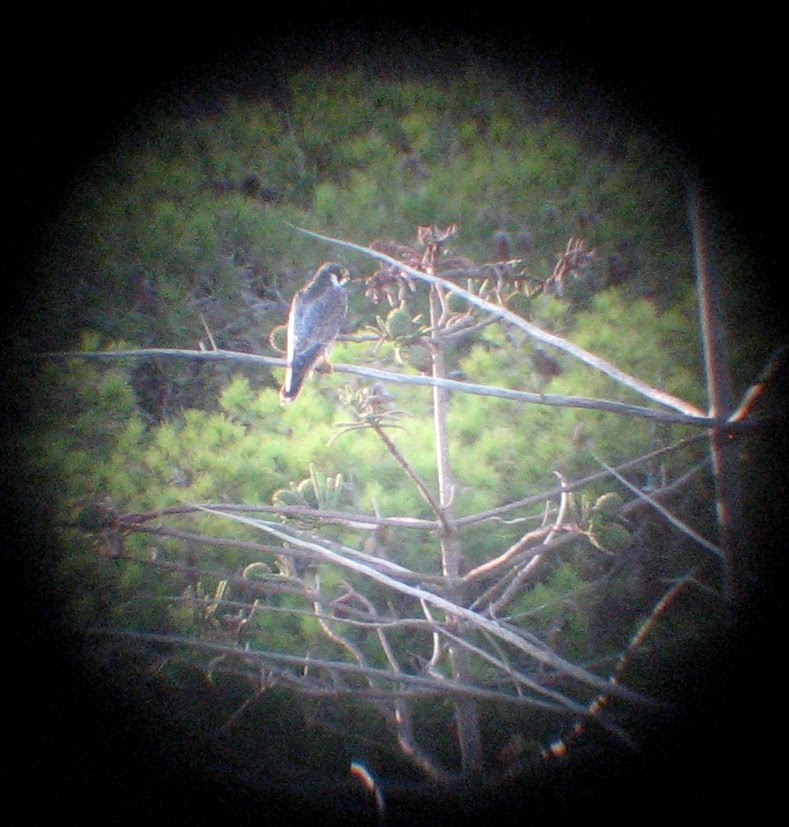
 Record shot of the highlight - Peregrine falcon
Saturday morning saw us still sleepy eyed scanning the sea with the sea spray blowing over us. At first only Yellow-legged gulls were about until a few Marsh harriers started coming in over the sea. Two Shovlers brigtened us up, being rather worthed to have got out of bed for. A Quail low over the sea heading inland was something I had never seen. So then with 17 Grey Heron and a Sandwhich tern just before we left I was quite happy.
Another seawatch Sunday morning gave 3 juvenile Audouin's gulls passing rather close to shore for gulls to be as well as my first two Black-headed gulls this autumn. Then 9 Grey Herons (2,7) and that was that, no more was to be seen.
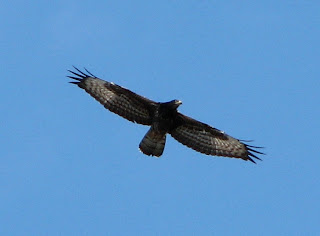
In the afternoon the wind had weakened so we tried our luck with some raptor watching. Not much migration, 35 Marsh Harriers and 25 Honey Buzzards in all, which cannot be expected now either with the peak being over. 8 Hobbies, 2 Kestrels and a good flock of 70 Bee-eaters were flying about. A Black Kite was a good find as usual but the most interesting was to be had from the Falcon family... a male Peregrine Falcon flew by and gave good views as it perched in a large tree. What's more the first Merlin flew or better speeded by soon before dusk.
Tuesday, September 21, 2010
One of those days!

12 Grey Herons from Qawra, the reddish colour on some of them is due to the early morning light.
 Just a very small part of the many flocks circling around over Malta this afternoon.
  Honey Buzzard silhouette
Whatever amount of hours and days you spend birding there are still those days that stand out in your memory for some time. That start good and end good, with a lifer or two and leaving you with a great feeling of content forgetting all the other birdless frustrating hours. Today was just such a day and to make it better it was the end of the summer holidays!
We started off with a Hoopoe flushed on arriving at the seawatching point at Qawra. We said that this made it worth even if we would se nothing else. But soon afterwards a flock of 12 Grey heron flew right over us,soon followed by a flock of 5 Little Egret. Not long after that again a flock of 9 Grey Heron and 13 Little Egret up the coast. Four more flocks of the latter were seen, 8, 18, 11 and 20, making up a very good total. The bird or birds of the morning were 4 Avocets which flew by Qawra point, not only being beautiful birds, but also rather scarce. By 9 am birds of prey started to make a move hinting on the passage that was to come later. A total of 12 Marsh harriers, 4 Honey Buzzards, an Osprey, 4 Common, 2 Lesser and 4 unidentified Kestrels. That was it, we left Qawra with hope to come up to Buskett as quickly as possible.
It was only two hours later though thanks to unreliable maltese buses! We came panting up the hill crossing fingers that we hadn't lost any large flocks or anything rare. Luckily the other birders had just arrived and the first flock of 6 honey buzzards was still ciricling around. The next flock was larger and with them 2 Ospreys. The flocks of Honey Buzzards and Marsh harriers didn't stop coming the largest of around 50 birds like bomber planes coming in formation over the maltese islands. They seemed to be in a hurry to escape the bad weather that is forecasted and although the first flocks migrated by the evening 300 or so raptors were circling around in huge funnels were ever you set your bins and still they were coming, a spectacle I had never witnessed in such "epic"proportions! While they stayed over Malta held by the now complete cloud cover, Kestrels(30), Lesser Kestrels (7) and Hobbies (20) were also migrating. To make it even better a male Pallid harrier was sighted, another two Ospreys - one with a ring seen blinking, a Black kite, 2 Grey and 2 Purple Herons. The best of all was a flock of 22 Spoonbills, a lifer for me and the largest flock seen by many present. We had been getting reports of them from the south of Malta but hadn't managed to see them, then a report from closer to us, from Dingli...a lot of frantic scanning and finally someone, who deserves a big thanks spotted them flashing white over Verdala Palace.
Totals of Marsh hariers and Honey Buzzards by the end of the evening were 350+ and 450+ respectively. Good numbers of Yellow wagtails (500+) and Swallows (600+) were noted as well as the first Grey Wagtail.
Saturday, September 18, 2010
Another good day up at Buskett
 Honey Buzzard
 Painted Lady
 At Qawra two hours of seawatching produced only two Marsh harriers, but at Buskett it was another matter. Maybe not as many as yesterday but just as fun. Arrived just in time to see a dark morph Marsh harrier. Small flocks were first found as mere specks in the sky gliding towards us stopping to soar overhead for a definite identification and continuing their migration agianst the wind. The way a good day should be. A Black Kite was seen in amongst the funneling Honey Buzzards and Marsh harriers as well as a male Montagu's harrier. 4 Hobbies were circling around attempting to catch Swallows and sending Bee-eaters into tight calling flocks. As dusk was approaching the raptors that had decided to choose our island as the stopover for the night started to drop lower in the sky stooping into the trees.
Subscribe to:
Posts (Atom)
.JPG)


.JPG)
.JPG)